





.jpg?width=75&name=magnus%20andersson_550x550%20(1).jpg)





-4.png?width=75&name=MicrosoftTeams-image%20(3)-4.png)





The shift towards more sustainable buildings is accelerating. At the same time, the HVAC industry is undergoing a significant transition, driven by evolving regulatory frameworks, the introduction of new refrigerants and increasing expectations on long-term environmental performance.
This transition is evident in air handling units (AHUs) with integrated heating and cooling functions. Lower Global Warming Potential (GWP) refrigerants are being introduced across the market, in line with regulatory pressure and climate targets. While the overall direction is clear, the selection of a suitable refrigerant is rarely straightforward.
This is because refrigerant choice is not determined by a single parameter, but by the need to balance multiple, sometimes competing, considerations.
A shift driven by climate and multiple other factors
Reducing GWP is an important and necessary step in lowering direct climate impact from HVAC systems. Alternative refrigerants offer significantly reduced GWP compared to legacy solutions. However, climate performance is only one part of the decision.
Other factors are equally relevant in system design and selection:
• Regulatory compliance at EU and national level
• Safety, including flammability classifications (e.g. A2L, A3)
• Chemical composition, including potential PFAS content
• Installation constraints and service/maintenance
• Operational robustness over lifetime
These aspects must be assessed together, and their implications can vary depending on the application.
The PFAS dimension: increasing attention, evolving regulation
PFAS (per- and polyfluoroalkyl substances) are receiving growing attention due to their persistence in the environment and potential long-term health concerns.
These substances are highly resistant to degradation and can accumulate in ecosystems and living organisms, therefore sometimes referred to as “forever chemicals”. Scientific studies have linked certain PFAS exposures to health risks, although the extent and relevance can vary between substances and exposure levels.
Within HVAC systems, PFAS may be present in some fluorinated refrigerants, as well as in associated materials such as lubricants, coatings or components. It is worth noting that PFAS content alone does not determine environmental impact: what matters more in practice is whether a refrigerant breaks down into trifluoroacetic acid (TFA) once released. Some refrigerants degrade into TFA readily, while others do so only marginally or not at all, meaning two PFAS-containing refrigerants can pose quite different real-world risks.
Regulatory scrutiny is increasing. In Europe, PFAS are being addressed under frameworks such as REACH, with ongoing discussions around broader restrictions. However, the regulatory landscape is still evolving, and timelines and scope are not yet fully defined.
Beyond compliance: Considering the people
Sustainability is not only about reducing environmental impact. It is also about creating healthier, safer environments for the people who interact with the systems throughout their lifetime – from installers and service technicians to the people who live and work in the buildings.
As new refrigerant technologies emerge, some solutions continue to rely on PFAS-based chemicals. While these may meet today's regulatory requirements, it is equally important to consider their long-term implications.
At Swegon, "Feel good inside" is about more than indoor climate. It also means caring for the people who interact with the systems every day. That's why we look beyond performance and today's regulations, considering how today's refrigerant choices may affect people and the environment in the long run.
Lower GWP refrigerants introduce new design considerations
Several of the new refrigerant alternatives, such as R32, R454B, R454C, R290 (propane) or R744 (carbon dioxide) offer lower GWP. At the same time, several of these alternatives come with different safety classifications and system pressure compared to traditional refrigerants.
Flammability and safety implications
While A1 refrigerants (non-flammable) generally present fewer flammability-related design constraints, refrigerants classified as A2L (mildly flammable) or A3 (highly flammable) require specific consideration in system design and implementation.
Depending on how the air handling unit is configured and local regulations, this may include:
• Limits on refrigerant charge or minimum room volume
• Requirements for leak detection and ventilation
• Consideration of leak scenarios in technical rooms or air streams
• Safety measures such as alarms, labelling and procedures
• Compliance with national fire safety requirements
The extent of these requirements depends on the specific application, installation environment, and applicable standards, not all systems are affected in the same way.
In the case of R744 (Co2), the higher operating pressure affects the choice of components and the overall system design.
Integrated AHUs require a system-level perspective
When heating or cooling functions are fully integrated in the air handling unit, refrigerant circuits may be located within the air handling unit itself.
This can influence how potential leakage scenarios are assessed, particularly in relation to airflows and system interaction.
Relevant considerations may include:
• How a potential leak interacts with the ventilation air stream
• The impact on components and occupied spaces
• Detection and mitigation strategies within the AHU may vary depending on where the unit is located
• Ensuring safe operation over time
It is also important to acknowledge that buildings evolve. Changes in room usage, layout or system configuration can alter boundary conditions. Designing for compliance at commissioning is therefore only one part of the challenge, maintaining safe and compliant operation over the full lifecycle is equally important.
Practical usability remains a key factor
In addition to technical and regulatory aspects, practical implementation is an important consideration. Installation and service conditions vary widely between projects, and not all stakeholders involved have specialist expertise in refrigeration or fire safety.
Depending on the chosen refrigerant, this can influence:
• The level of specialist competence required
• Installation complexity and commissioning processes
• Dependency on certified or specialised personnel
• The risk of incorrect handling or deviations from intended design
These factors can be particularly relevant in standardised or decentralised AHU applications, where simplicity and repeatability are often important.
Multiple viable refrigerant pathways
The current refrigerant landscape includes several alternatives, each with different characteristics:
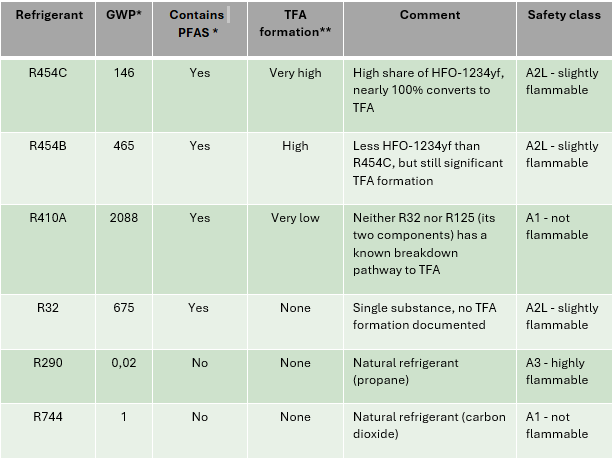
* GWP according to latest F-gas regulation, PFAS content according to OECD 2021 definition
** In short: PFAS content is about what the substance IS; TFA (trifluoroacetic acid) formation is about what it BECOMES once released - and that is what mainly drives the real-world environmental risk. PFAS content describes the molecule's structure - strong carbon-fluorine bonds, which is why it works as a refrigerant. Some PFAS refrigerants (like R454B/C) break down in the atmosphere into TFA, a highly persistent substance that spreads through soil and water. Others, like R410A, break down through different pathways where TFA barely forms.
Each option offers benefits in certain areas, while introducing limitations or additional requirements in others.
As a result, different air handling unit manufacturers and project stakeholders may prioritise different solutions, depending on how they weigh factors such as energy performance, safety, flexibility inside the building, regulatory outlook and system complexity.
Navigating complexity with informed choices
The transition to lower-GWP refrigerants is necessary and ongoing. At the same time, it introduces a higher level of complexity in system design and decision-making.
There is no single solution that is optimal for all applications. What becomes increasingly important is:
• Understanding the relevant trade-offs
• Evaluating solutions in their specific context
• Making informed, transparent decisions
Ultimately, refrigerant selection is not only a technical parameter. It is a long-term decision that affects system performance, safety, compliance – and the overall responsibility for the building throughout its lifecycle.
A balanced path forward – tailored to application and responsibility
Swegon is in many aspects considered a pioneer in sustainability. In our GOLD/SILVER AHU’s the traditional steel is now to a large extent replaced by recycled and renewably produced steel.
We recognise that the transition to new refrigerants is both necessary and complex. For us, it is important not only to follow developments, but to make well-considered choices that are sustainable over time. Rather than focusing on a single parameter, our approach is based on evaluating the full system context, including safety, performance, regulatory outlook and long-term responsibility.
Therefore we are not promoting a single “best” solution, but enabling informed decisions, based on transparency and a thorough understanding of trade-offs.
Indirect adiabatic cooling
With indirect adiabatic cooling, limited cooling power can be added to the supply air without the use of refrigerant. The technology is already used in several markets, which shows an alternative path for cooling installations.
Existing offering with low GWP refrigerants
Swegon is an established supplier of chillers and heat pumps utilising low-GWP refrigerants, continuously leveraging its expertise to evaluate and develop suitable solutions for different applications.
Already today, Swegon offers split solutions, enabling the use of refrigerants such as R32, where their specific properties can be managed effectively. Combined with Swegon's intelligent SMARTLink DX control technology, these solutions provide efficient temperature control. This approach allows a lower GWP and PFAS-free solutions, while addressing safety and technical requirements through system separation and controlled installation environments.
Swegon also offers hydronic solutions based on packaged chillers and heat pumps using R290 (propane), connected to AHUs and room units through dedicated hydronic circuits. These systems can be optimised through Swegon's SMARTLink+ control technology, helping to reduce energy consumption while maintaining system performance and a very low GWP.
In addition, Swegon recently launched a packaged air-to-air rooftop heat pump utilising natural refrigerant CO₂.
With a broad portfolio available, the most suitable solution is selected based on project requirements, installation environment, application, and customer needs.
Integrated solutions (GOLD RX/HC and GOLD RX/C)
Today based on the established refrigerant R410A, offering a well-known safety profile, robust performance and straightforward installation in standard applications. Under the EU F-Gas Regulation it remains compliant and available on the market until 2030. We are currently developing an alternative refrigerant solution to reduce the environmental impact, while maintaining system safety, usability and reliability. GOLD is – and will continue to be – an adaptable, flexible unit as building needs change.
This balanced approach reflects our way of navigating an evolving landscape, considering environmental impact, safety and practical implementation together. Rather than applying one solution across all scenarios, we match the technology to the application.
Transparency and respect for complex decisions
We do not believe in shortcuts or oversimplified answers. We believe in transparency, thoughtful decision-making and respect for the full lifecycle of buildings.
Whether an approach is right or wrong is for each individual to judge. This is how we choose to work. With people, the environment, and the future at the heart of every decision.