





.jpg?width=75&name=magnus%20andersson_550x550%20(1).jpg)






-4.png?width=75&name=MicrosoftTeams-image%20(3)-4.png)





When thinking about an air handling unit (AHU), it is natural to focus on what happens inside it: fans, filters, heat exchangers, control systems and heat recovery. But one part of the air handling unit that is just as important as the components, is the casing. William Lawrence and Åse Esselius are two of Swegon’s many experts, here they explain the advantages of designing an AHU casing in another material than steel: composite.
The casing of an air handling unit does far more than enclose the many components of the unit. It contributes directly to performance, longevity and overall reliability of the AHU, influencing corrosion resistance, thermal transmission, thermal bridging, airtightness, mechanical strength, weight and maintenance needs.
Outside an air handling unit, the casing may be exposed to rain, UV radiation and changing temperatures. Inside, air can be warm, cold or highly humid. Condensation can occur and, depending on the application, the air may also contain aggressive substances.
In some environments, the conditions are particularly challenging. Think about an indoor swimming pool, where high humidity is combined with chlorides and disinfection by-products. Or food production facilities, where strict hygiene requirements and frequent chemical cleaning are part of everyday operation. In laboratories, pharmaceutical production and similar applications, reliable, clean and corrosion-resistant air treatment is essential.
These are just a few examples of why material choice matter. It matters in many other ways too, not the least in terms of longevity and climate impact.
Why is composite so smart?
A composite is a material made by combining two or more constituent materials with different properties to create a high-performance solution.
Unlike many metals, composites do not rust. They do not rely on paint, galvanising or other surface treatments to protect the material from corrosion. For an air handling unit, that makes a significant difference considering both the external and internal conditions mentioned above.
Composite materials can also perform exceptionally well in terms of thermal transmission and thermal bridging, both which are essential for efficient temperature control.
The combination of strength and low weight is also something that makes composite relevant for an air handling unit. A composite construction can be considerably lighter than a comparable metal construction, which can make a real difference when installing large air handling units, particularly on rooftops or in buildings where structural load is an important consideration.
For many air handling units, cleanability is just as important as performance or durability. Composite can be constructed with a completely flat and smooth surface that is easy to clean and highly resistant to cleaning agents containing chemical additives. It can also be designed according to standards such as VDI 6022 for applications with high hygiene requirements.
Further, the absence of corrosion also matters in this. Repeated cleaning and exposure to moisture can be particularly demanding for traditional materials and surface treatments. With composite, the material itself provides corrosion resistance.
Knowing all this, the question changes from: How can the material be protected from the environment? To: Is it possible to design a top-class air handling unit around a material that already handles the environment? This is where LIBERTY and composite technology is put in the spotlight.
LIBERTY has excellent corrosion resistance
Corrosion is one of the biggest enemies of a long-lasting air handling unit. However, this unique composite air handling unit features a casing designed to withstand even extremely corrosive environments. Its standard casing construction is classified for a long service life according to ISO 12944-2 and aligns with the highest corrosion category, CX Extreme (beyond C5 classification).
The casing, internal partitions, support profiles and foundation frame can all be made from corrosion-resistant composite as standard. The result is a casing where corrosion is not something that needs to be managed through repeated surface treatment.
Great thermal performance and air tightness
An air handling unit must control temperature efficiently. That means the casing itself needs to perform. LIBERTY units use 70 mm composite panels and achieve the highest classifications for thermal transmission and thermal bridging: T1/U1 and TB1.
The panels are also completely closed and vapour-tight. This helps minimise the risk of unwanted condensation and moisture penetrating the construction, which is particularly important in humid environments.
In other words, the casing is not simply a box around the air handling unit. It is part of the overall thermal performance of the system.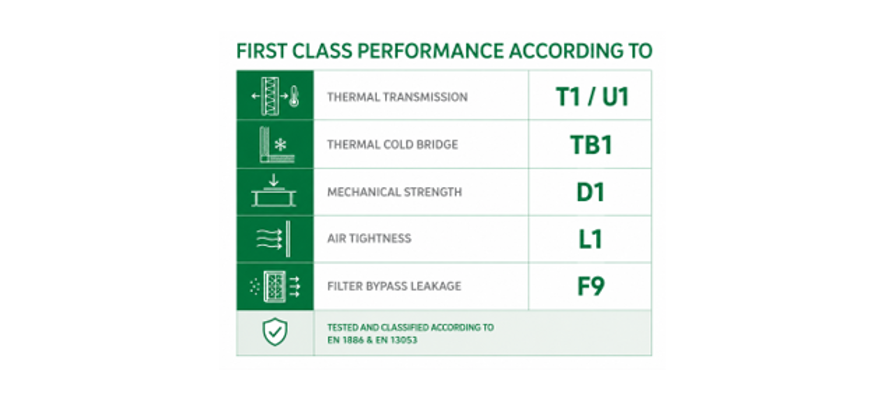
LIBERTY is strong, but lightweight
Composite does not mean compromising strength. LIBERTY's casing is classified D1 for mechanical strength, which means that a composite construction can deliver structural strength without unnecessary weight.
Best classification in air tightness
There is little point in investing in an efficient fan and heat recovery system if treated air is lost through the casing. LIBERTY achieves the best classification, L1, in air tightness.
Designed for hygiene and cleanability
As mentioned, in food production, healthcare, pharmaceutical applications and other hygiene-critical environments, the inside of an air handling unit must be easy to inspect and clean. LIBERTY has a flat and smooth surface that is easy to clean and highly resistant to cleaning agents containing chemical additives. It can be designed according to VDI 6022 for applications with strict hygiene requirements.
Less maintenance, fewer replacements
Because composite is corrosion resistant, the LIBERTY casing does not require the same type of repeated surface treatment associated with protecting metal against corrosion. This is an important benefit, as it reduces the need for maintenance and downtime.
A sustainable unit is an additional benefit to good performance and reliability
Composite is a strong material, but it is not the only factor that gives LIBERTY a long service life. It is also because many of the factors that normally contribute to deterioration have already been addressed at the design stage. With that, a long service life is not only the result of material selection, but also good engineering. In the bigger perspective, it is also an important part of sustainability.
When discussing sustainable ventilation, conversations often start with energy efficiency. And rightly so. An air handling unit operates for many years, often continuously, so reducing energy consumption is essential. However, the sustainability advantages do not end with operational energy use.
Going back to the weight parameter of a composite unit, a lighter air handling unit can have an impact beyond installation. Lower weight can reduce the resources required throughout parts of the manufacturing, transport and construction chain. Research from EuCIA indicates that composites can have a 54% lower carbon footprint than aluminium and steel in the comparison cited by LIBERTY.* That does not mean that the material choice alone makes an air handling unit sustainable. It means that material selection can be an important part of a broader sustainability strategy.
A casing that lasts longer, requires less maintenance and retains its performance is therefore not just a technical advantage. When that longer service life reduces the need for replacement and the use of new materials is postponed, it becomes a sustainability advantage as well. And probably also an economic advantage.
LIBERTY is designed not only to meet today’s performance and reliability requirements, but for many years of continuous operation. The 12-year casing warranty is a clear expression of that confidence.
*Source: Composite materials, EuCIA