





.jpg?width=75&name=magnus%20andersson_550x550%20(1).jpg)





-4.png?width=75&name=MicrosoftTeams-image%20(3)-4.png)




To achieve a good indoor climate with low operating cost the ventilation solution must be designed and installed in a proper way so that energy losses are minimised and air quality preserved. This means that it must be airtight and well insulated but also be formed to allow cleaning. Something that applies to the whole duct system including the ventilation unit. Our expert, Anders Jakobsson, Technical Product Manager, will explain further.
For the duct system, there are standards that describe how the ducting shall be insulated, the maximum allowed leakage rates and requirements for cleaning access. But what about the casing of the air handling unit (AHU)?
The casing of an air handling unit has an important role to play. It contains the vital components of the unit, and it too needs to provide good insulation and minimise leakages. At the same time, it needs to allow for easy access to fans, filters and heat exchangers for maintenance.
With a poor casing there is a risk that the energy performance and air quality are affected. Which is why, there is a considerable amount of product development and testing behind a well-functioning casing.
Air handling unit classifications
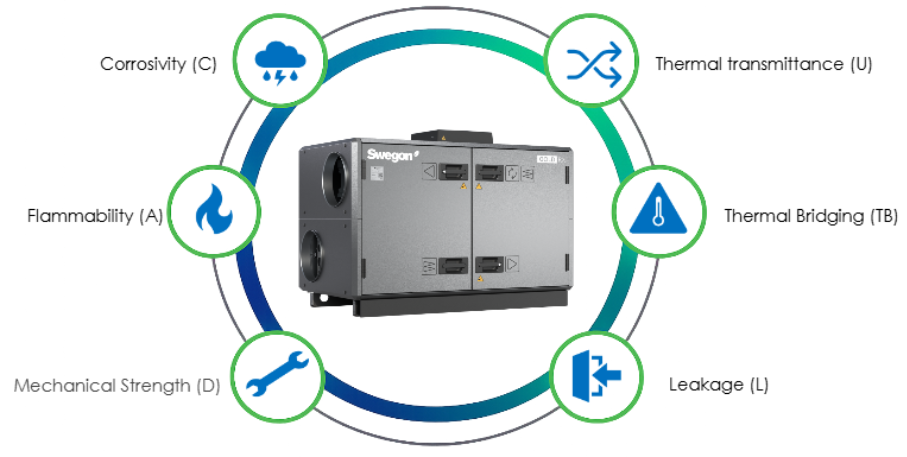
The quality of an air handling unit casing is described by a series of characteristics that rate the thermal and air leakage performance. These ratings are defined in the recently updated international standard EN1886:2025; which also defines how these shall be measured.
The classifications are: mechanical strength, air leakage, filter bypass leakage, thermal transmittance, thermal bridging and acoustic insulation.
Mechanical strength
The mechanical strength of the casing is defined as the measured relative deflection of the outer surface of the casing, when the pressure in the unit is 1000 Pa positive and negative pressure. To be classified as D1, the deflection must be under 4mm/m. Up to 10mm/m deflection is D2, and more than 10 mm/m is D3. The measuring procedure also includes testing at maximum declared pressure to confirm no permanent deflections.
Leakage
Air leakage from the AHU casing impact energy performance, its functionality and has a hygiene impact. Air leakage has three classification levels for casings: L1, L2 and L3, where L1 means minimised leakage. Generally speaking, L3 is suitable for applications with low to medium filtration, L2 for medium to high filtration and L1 for very high or HEPA class filtration. L2 is the most appropriate class for most comfort applications.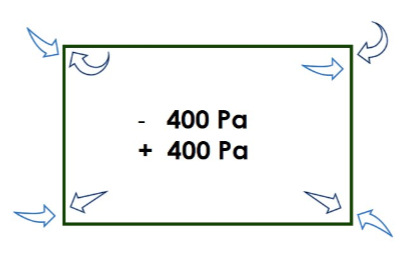
Filter bypass
For an efficient air filtration, the filter bypass classification is essential. Leakage at the filter frame and through the casing, between the filter and fan, will impact the supply air quality which is why it is important that filters are installed in frames with a low leakage rate. The leakage rate should be aligned with the intended filter class. A filter frame is classified by the leakage flow expressed as a percentage of the nominal airflow. To be classified F9, leakage flow must be below 0.54%. By comparison, a filter frame classified as F7 may leak up to 2% of the nominal flow.
When the filter bypass leakage is too high, filtration loses efficiency as polluted air can by-pass the filter. For filters located in an AHU section with negative pressure. i.e. upstream from the fan, it is also essential to ensure a low enough casing leakage. Otherwise, polluted air can enter through the casing downstream the filter where the air is expected to be clean. Consequently, both external leakage and internal filter bypass need to be sufficient for the required filter grade.
Thermal transmittance
Thermal transmittance, also known as the U-value, indicates heat energy loss through the casing. It is measured in W/m²K, and requires a defined temperature difference between inside and outside of the casing in a steady state. In the latest update of EN 1886:2025 the casing classification for thermal transmittance was changed to U-class instead of the earlier T-class, illustrated in the graph below.
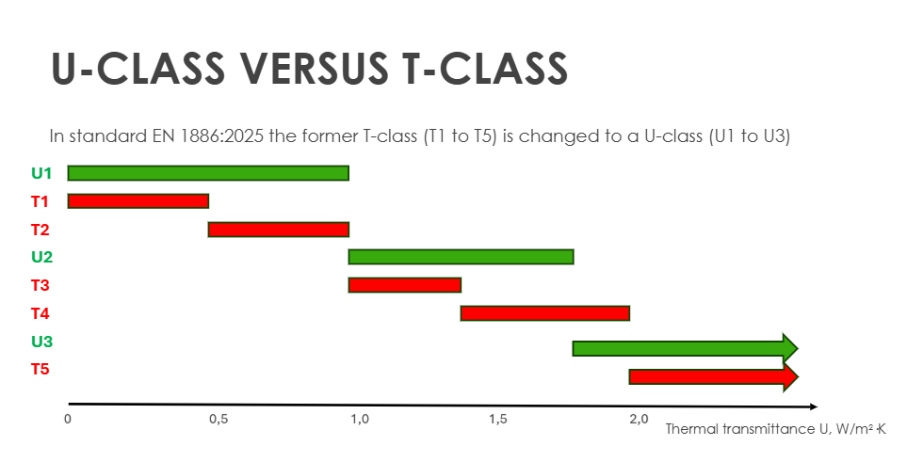
Three classifications are defined for air handling units: U1 to U3, where U1 allows the lowest losses, up to 1 W/m²K. Air handling units are subjected to the same temperature differences as the building envelope, though the surface area is obviously a lot less. A U1 classification means insulation similar to that of a good quality exterior door, which is appropriate for AHUs. U3 indicates that the unit has energy losses of more than 1,8 W/m²K without any upper limit, unclassified in practice.
Thermal bridging
Thermal bridging also causes heat losses, but the main problem is condensation. Condensation needs to be avoided as it can lead to corrosion and hygiene issues. In cold climates it can even lead to ice formation on the casing.
Four classes are defined from TB1 to TB4 where TB1 is the highest classified level, and TB4 the lowest. In this test, the temperature in critical spots of the casing surface is measured together with the air temperature inside and outside the casing. A thermal bridging factor (kb) is calculated, which gives difference between the ambient temperature and the temperature of any point on the outside surface of the casing. It is the ratio of the internal to surface temperature and the internal to ambient temperature. The theoretical maximum and best value of kb is 1.0.
With a classification of TB2, the risk of condensation on the casing of a unit placed in a plantroom with normal temperature and humidity is low, even in winter when cold outdoor air enters the unit. With a TB3 or TB4 classification the risk of condensation or frost on the casing increases.
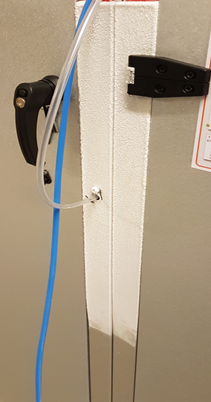
Photo shows a unit with frost build up due to high thermal bridging when temperature inside the unit is low
Acoustic insulation
The acoustic insulation is defined by the insertion loss of the casing. The insertion loss explains how much noise from inside the unit is reduced by the casing. It is given for each frequency band.
Eurovent certification and recommendations
A vital part of Eurovent Certification for air handling units is the measurement and classification of these casing characteristics. It is therefore carried out in an independent laboratory that ensures testing is carried out in a fair and proper way.
Tests are carried out on a model box with prescribed dimensions, manufactured using the same casing design as the AHU. This allows casing performance of different air handling units to be compared.
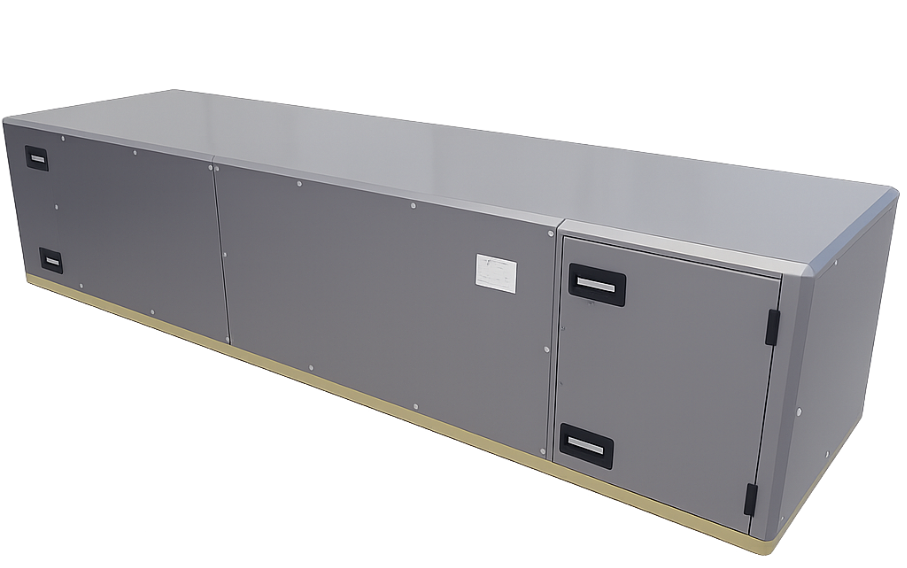
A model box i a representative section of an air handling unit used to evaluate and verify casing performance characteristics such as thermal bridging, air leakage, mechanical strength and thermal transmittance.
Actual units are also tested and the results can differ. This because actual units have more doors and there are penetrations through the casing wall for ducts, cables and pipes. The classifications are published by Eurovent for both model box and actual unit.
Turn to Eurovent certification, for more information.
In addition to the certification, Eurovent has published Quality criteria for Air Handling Units (Eurovent 6/18-2022) to serve as a comprehensive checklist and guideline for consultants, building owners and designers. It supports these stakeholders in evaluating casing properties, energy efficiency, maintenance and technical documentation. The aim is to prevent poor indoor air quality and excessive operating costs.
In this mentioned publication, Eurovent mentions required performance classes and gives recommendations on flammability class for insulation materials as well as casing material corrosivity resistance.
Flammability
Flammability reaction of insulation material is classified from A to F, in some cases with sub-criteria for smoke generation, s1 to s3, and flaming droplets, d0 to d2. A1 is the highest classification, a non-flammable class without smoke generation or flaming droplets, while F is highly flammable.
Corrosion
Corrosivity classes, C1 to C5, and the additional CX defines the corrosivity in different environments. C1 is a clean and dry indoor area with a very low corrosivity, while C5 is an industrial or offshore area with very high corrosivity. The additional CX class represents a severe industry or tropical offshore environment with extreme salinity and humidity, providing an extreme corrosivity level.
The GOLD and SILVER casing
Here GOLD/SILVER ranges are used as examples, as they represent our most sold air handling units and have been installed in various applications worldwide. These are used as reference, to exemplify how well the casing meets the Eurovent recommendations.
The GOLD/SILVER casing is designed to meet or exceed Eurovent’s quality criteria for use in a wide range of applications. Good thermal and leakage properties are achieved in combination with high quality material selections.
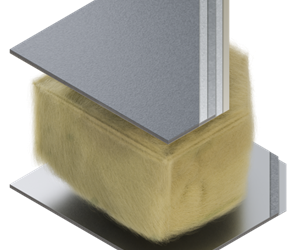
GOLD panel with mineral wool insulation and recycled steel with high quality corrosion protective surface treatments.
The Swegon GOLD/SILVER units are classified as follows:
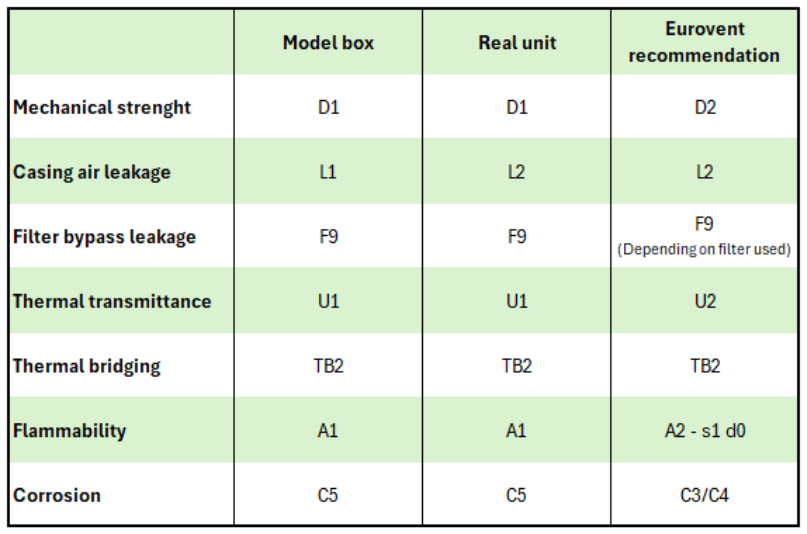
Acoustic insulation of the GOLD/SILVER casing per frequency band:

Swegon offers a wide range of air handling units, each designed to meet the requirements of different applications and operating conditions. While the recommendations presented in this section are exemplified through GOLD/SILVER, the principles can also provide valuable guidance when selecting and evaluating casing performance across other AHUs within the Swegon portfolio.