











In previous blog posts we have discussed demand controlled ventilation (DCV) and why it is a smart investment. However, VAV, which stands for variable air volume, and demand controlled ventilation are often discussed together. Here our expert, Niklas Jacobsson, Product Manager, explains the actual differences between the two. Niklas will also highlight the importance of choosing the right system to ensure an efficient building operation, a comfortable indoor climate and future compliance with various regulations.
VAV and DCV systems essentially serve the same purpose: adjusting the ventilation and air conditioning in response to varying activity levels in a room or building. Generally speaking, the more advanced the system, the higher the energy efficiency and the greater the indoor comfort. Further, improved energy efficiency often goes hand in hand with lower emissions and advanced systems can simplify daily operations. In other words, there are several benefits associated with VAV and/or DCV systems.
There are quite a few acronyms for the different types of ventilation control systems, but the three most common are:
CAV – Constant air volume
VAV – Variable air volume
DCV – Demand controlled ventilation
It should be noted that this blog post does not aim to discuss CAV in any detail, as its focus is on explaining how to reduce operating costs and comply with future energy regulations.
So, what are the differences and advantages of the other two options, VAV and DCV?
VAV
- A basic method for adjusting the indoor climate to a certain need.
- Builds on stand-alone products at room or zone level, which can be integrated into a BMS or other control system.
- Allows airflow to be varied during operating hours and can be adjusted in response to occupancy and temperature.
- Most often, VAV meets the requirements specified for less technically focused buildings where only simple adjustments are needed.
- VAV offers a significant reduction in energy consumption compared with CAV system.
DCV
- An advanced approach to adjusting the indoor climate to an exact need.
- Adjusts airflow and temperature in response to actual demand and occupancy levels in rooms, this to cater for differing use patterns.
- Enables improved energy savings thanks to advanced control functions that has the ability of considering an entire building.
- Handles a combination of airborne and waterborne products and creates an integrated indoor climate system.
- Offers extended options for optimising energy efficiency, which is advantageous in buildings with high energy demands related to ventilation and air conditioning.
- Acts as a key enabler for achieving exemplary classifications under certification programmes such as BREEAM, WELL and LEED
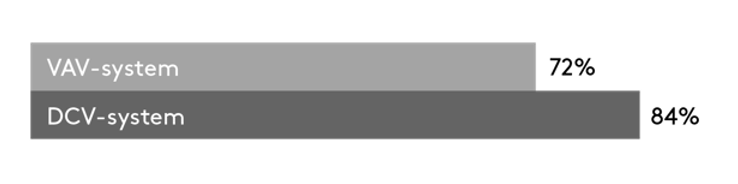
Both these options, enables reduced energy consumption and often an improved indoor climate compared with CAV. A comparison of air flow (m3/h) responding to the occupancy rate in a given space revealed that a basic on/off VAV system was able to reduce flow by 72%, while a DCV system achieved reductions of as much as 84%, again compared with a CAV system.
A comparison of air flow (m3/h) depending on the occupancy rate in a given space revealed that a basic on/off VAV system was able to reduce flow by 72% and a DCV system by as much as 84% as compared with a CAV system.
However, the above is quite narrow-sighted considering the many advantages of VAV and DCV systems. There is a total energy and emission gain of these systems that is best understood from a lifecycle perspective and through calculations of embodied carbon emissions. We have completed a deeper analysis on these two parameters, using IDA ICE for next level simulations. Find a link to this analysis at the end of this blog post.
To summarise this blog post, a VAV system is perfectly adequate for buildings with less technically driven requirements and with a somewhat lower ambition level in terms of energy savings. At Swegon, our REACT system aligns entirely with these needs and offers additional benefits of being built on stand-alone products on room or zone level, which can be integrated into a BMS or other control system.
A DCV system, on the other hand, is developed to meet highly stringent and/or varying indoor climate requirements. It enables a level of precise control and adjustment capabilities that cater for the intelligent buildings that are becoming increasingly common and are often required to achieve environmental certification and compliance with various EU regulations, such as EPBD.
At Swegon, we offer a DCV system called WISE. In addition to the benefits already described, WISE fulfils BACs requirements and thereby ensures that a building is future proofed. Finally, it is supplied as an integrated product and system solution, ready to use, which reduces project costs related to both installation and commissioning.
