


.jpg?width=75&name=sigvardsson_220628_0008_small_webb%20(1).jpg)





.jpg?width=75&name=magnus%20andersson_550x550%20(1).jpg)





-4.png?width=75&name=MicrosoftTeams-image%20(3)-4.png)




There is a growing and unified understanding that the building sector needs to reduce both its operational energy emissions and embodied carbon emissions. This shift is clearly stated in the Energy Performance of Building Directive (EPBD). However, the latest revision of EPBD further tightens the framework and moves from near zero energy buildings (nZEB) to zero-emission buildings (ZEB). With that, our expert Luca Filippetto, Cooling & Heating Product Manager at Swegon, highlights the urgency to engage with already available measures to realise ZEBs within the 2028–2030 implementation timeline.
The 2024 recast of the Energy Performance of Building Directive (EPBD) from EU introduced an update to the previous near zero-energy buildings (nZEB), now instead zero emission buildings (ZEB). The definition reads “a building with a very high energy performance […], requiring zero or a very low amount of energy, producing zero on-site carbon emissions from fossil fuels and producing zero or a very low amount of operational greenhouse gas emissions”.
Difference between nZEB and ZEB
The requirements that differentiates ZEB from nZEB are focusing on emissions overall, not only energy consumption.
Each EU member state must set maximum thresholds for the following indicators:
- Total Primary Energy Usage (TEPU, measured in
 ), which must be at least 10% lower than what was established for nZEB
 - Operational Global Warming Potential (measured in
 )
)
Each EU member state shall also ensure that the total annual primary energy use of a ZEB is covered by energy from:
- renewable sources generated on-site or nearby
- renewable sources provided from a renewable energy community
- efficient district heating and cooling systems
- carbon free sources
In a commission notice about EPBD issued in June 2025, it was clarified that “One possibility is that the total primary energy use of a ZEB over a year is fully and continuously covered by one or more of the options under a) to d). However, a ZEB may also temporarily be supplied by other energy sources, including energy with carbon content, and compensate this non-compliant energy, on an annual basis, by the renewable energy produced on-site and either used on-site for non-EPB uses or exported to the grid.”
In this context a ZEB can be either:
- a "net zero not-renewable energy building"
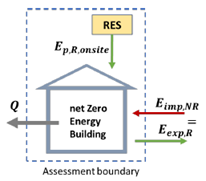
-
a "zero not-renewable energy building"
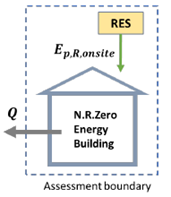
Where:
 = renewable energy produced on-site
 = non-renewable imported energy
 = renewable exported energy
Digital demand response
A ZEB shall also “…where economically and technically feasible, offer the capacity to react to external signals and adapt its energy use, generation or storage”.
In the already cited commission notice the following example is reported: “The ZEB has (digital) demand response and demand management capabilities, at building level or at the level of the main equipment, meaning that, at electricity grid peak hours, the supply from a technical building system of the ZEB can be temporarily turned off or postponed, potentially based on a pre-defined protocol“. As an example, meaning that a heat pump may be turned off if the temperature is within a certain acceptance span.
The ZEB requirement will become mandatory for all new public buildings from January 1st, 2028, and for all new buildings from January 1st, 2030. With all this taken into account, a recommended way forward to realise a zero-emission building after 2028/2030 featuring both heating and cooling for a comfortable indoor climate will be to:
- Select a reversible heat pump, or polyvalent unit, have it installed on-site and powered by a solar panel plant which is either running with a battery solution or connected to the electricity grid.
- Connect the building to an efficient district heating and cooling system
or a combination of these.
At Swegon, the Mission Zero-emission was established in 2023. Within that idea, our heat pumps with natural refrigerants make up the core of our offer suitable for zero-emission buildings (ZEBs). This much due to the following:
- Zero on-site carbon emissions from fossil fuels
- The natural refrigerant, R290, with a GWP close to 0
- The control options for demand operation upon external signals, see our blogpost on heat pump operation, energy efficiency and cost reduction.
Heat pumps are one enabler
The industry is imposed to move from near zero to zero-emission buildings (ZEBs). In that transition, heat pumps from Swegon emerge as one key enabler in meeting both performance requirements as well as regulatory ambitions of the EPBD. Their ability to operate without on‑site fossil fuels, with very low global warming impact from using natural refrigerants and the ability to respond to external signals make them well-suited. When properly integrated with renewable energy sources, heat pumps offer a robust and future‑ready solution that aligns with the determined frameworks.
Worth noticing, is that the targets for zero-emission buildings are incredibly ambitious. From Swegon, we can provide the industry with a wide range of product and service solutions that support the aim of realising ZEBs, however, we believe that the industry needs to work together for this transition to take place on a large scale and across the Union.