

















Energy efficiency has become one of the defining priorities for the building sector. Rising energy costs, increasingly ambitious sustainability targets and evolving regulatory requirements are placing greater pressure on building owners, operators and investors to understand exactly how their buildings perform. At the centre of this performance is the air handling unit (AHU): the heart of the indoor climate solution and one of the key components influencing both indoor environmental quality and energy use. Here our expert, Nicklas Svensson, Product Manager, explains. For the reasons mentioned above, efficiency can no longer be treated as a design ambition alone. It must be visible, measurable and continuously optimised in daily operation. This makes the combination of a high-performance air handling unit and meaningful operational data increasingly important.
Many buildings rely on advanced indoor climate solutions to minimise energy consumption and reduce operational costs. However, even a high-performance air handling unit needs the right performance data to show whether it is operating as intended and where it can be further optimised.
Questions such as the below are becoming increasingly common across the industry:
• Are the units and systems operating as efficiently as intended?
• How can operating costs be reduced without compromising indoor climate?
Why better energy insights matter
Access to reliable performance data offers benefits far beyond simple energy monitoring. For building owners, it provides greater control over operating costs and enables proactive optimisation rather than reactive maintenance. For facility managers, it offers enhanced visibility into solution performance, helping identify deviations before they become costly issues.
Effective control of liquid flow through GOLD heating and cooling coils is essential yet often overlooked. Measuring the flow and the inlet and outlet liquid temperatures enables accurate energy reporting. Valve leakage alarms also help prevent unnecessary energy use.
Ultimately, clearer insights enable better decisions, often resulting in lower energy use, reduced costs and improved building performance.
Reporting is becoming a strategic advantage
Regulatory frameworks and sustainability initiatives continue to evolve, bringing increased emphasis on transparency and measurable outcomes. From ESG reporting* and carbon reduction strategies to building certifications and the revised Energy Performance of Buildings Directive (EPBD), organisations are increasingly expected to provide documented evidence of how buildings perform in practice.
Collecting and managing this information manually can be both time-consuming and resource intensive. Having access to accurate, continuously updated energy data not only simplifies reporting processes but also creates a stronger foundation for sustainability initiatives, compliance requirements and future investment decisions.
Introducing Energy360
As the heart of the indoor climate solution, the air handling unit has a direct impact on a building's energy profile. GOLD air handling unit is designed to deliver efficient air handling, but the next step is to make performance transparent in operation so that optimisation opportunities can be identified and acted on over time. With the latest generation of our GOLD air handling unit, we introduce Energy360: a concept that connects energy performance, operational insight and optimisation in one clear approach.
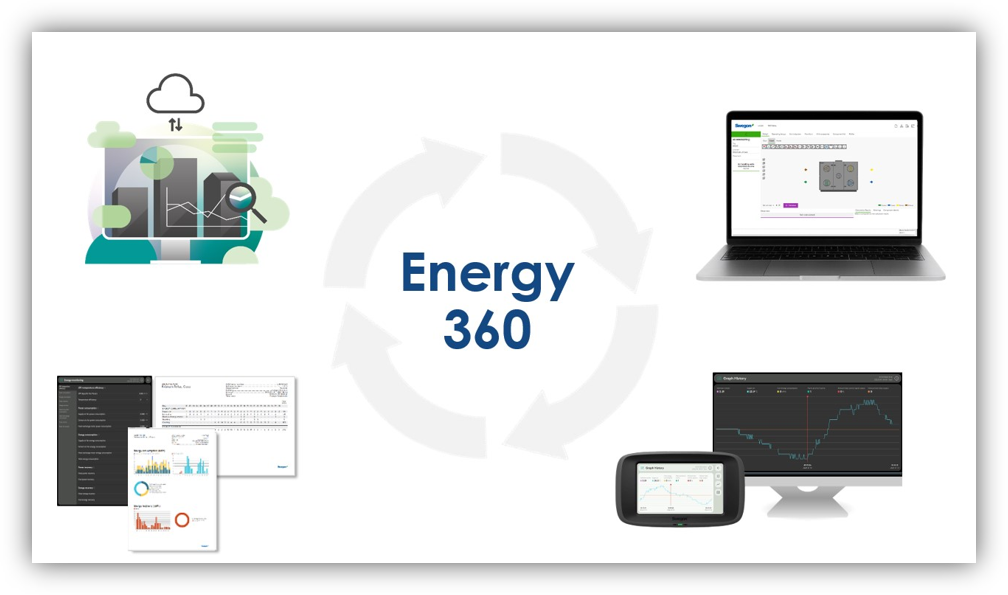
Instead of looking at operational performance as isolated data points, Energy360 helps make the energy impact of GOLD visible across planning, monitoring, analysis and reporting. This gives building owners and operators a stronger basis for identifying where performance can be improved and how energy use can be optimised over time.
By focusing on optimisation, Energy360 can help customers:
• Understand how GOLD contributes to the building's total energy performance.
• Identify deviations and optimisation opportunities earlier.
• Reduce unnecessary energy consumption while maintaining a good indoor climate.
• Follow improvements over time with clearer energy reporting.
• Support sustainability documentation, certification schemes and investment decisions with reliable operational data.
This makes GOLD more than a high-performance air handling unit. With Energy360, it becomes an active part of the building's energy strategy, helping customers move from measuring performance to improving it.
Energy 360 turns energy data into action through four main areas: preparation, monitoring, reporting and optimisation.
Preparation: Calculate energy consumption, operating costs and life cycle costs (LCC), compare energy performance between different units and identify energy-efficient functions customised for the project and the unit
Monitoring: Get real-time insights into heating, cooling, fan operation, airflow, temperature efficiency, valves, liquid flow, leakage alarms and more. Use continuous measurements and visualisation to simplify performance verification, compliance and reporting.
Reporting: Benefit from customisable reports through INSIDE Portal, web interfaces or integration with own reporting systems.
Optimisation: Make use of remote monitoring, unit comparison and data analysis to enable proactive improvements and greater energy efficiency.
Lower energy bills through better optimisation
For customers, the value is tangible: better insight creates better opportunities to optimise.
When the energy performance of GOLD is visible in operation, it becomes easier to identify where energy can be saved, where adjustments are needed and how improvements can be documented over time. In addition, access to reliable operational data can make it easier to support environmental certifications, sustainability reporting and compliance with evolving requirements such as EPBD**.
In a reality where efficiency, transparency and accountability are becoming increasingly important, the ability to understand and optimise building performance is no longer simply an advantage, it is rapidly becoming a necessity.
With Energy360, GOLD air handling unit represents more than an air handling unit. It becomes the heart of a more informed, measurable and continuously optimised indoor climate strategy.
*ESG reporting is the disclosure of a company's environmental, social, and governance data to show its impact on sustainability and ethical practices.
**The purpose of the EU Energy Performance of Buildings Directive (EPBD 2024/1275) is to halve emissions from the building sector by 2030 and reach a fully carbon-neutral building stock by 2050.